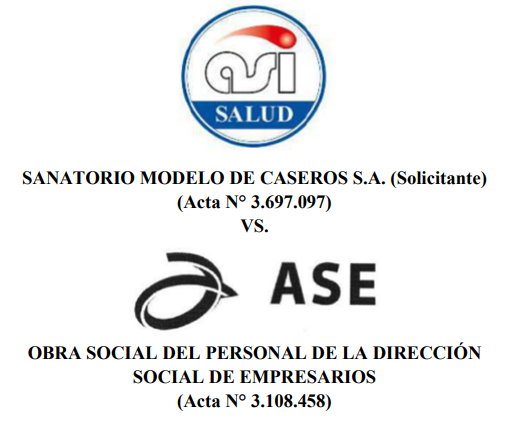
On October 8, 2026, the Federal Civil and Commercial Court of Appeals confirmed that “ASI SALUD” (a design trademark) may coexist with “ASE” in Class 44, which covers medical services. The Obra Social del Personal de Dirección Acción Social de Empresarios (ASE) had opposed the registration sought by Sanatorio Modelo de Caseros. It argued that the roots were nearly identical, as only one letter differed. The Argentine National Institute of Industrial Property (INPI) rejected the opposition, and the Court upheld that decision, with costs to be borne by the opponent.
Why is there no likelihood of confusion? The court acknowledged a certain similarity in the “AS” root but clarified that this does not, in and of itself, imply a likelihood of confusion. The decisive factor is that a party sharing an element with a prior trademark must incorporate other features that eliminate the risk of confusion. In this case, it did so by adding “SALUD,” the circle with a double blue line, the special lettering of “ASI,” and the red mark above the “I.” Phonetically, the different final vowel and the additional term make them sound different. Conceptually, “ASI SALUD” refers to the owner’s business activity, whereas “ASE” is a fanciful mark.
The Court acknowledged that “SALUD” is in common use in Class 44 and that no one can monopolize it. Even so, in this case, that word, placed below “ASI,” ended up being one of the elements that gave the sign “distinctive projection,” along with the design. Furthermore, it noted that evocative trademarks are “weak trademarks”: their owner must tolerate others evoking the same concept, provided the trademark incorporates elements that allow it to be distinguished. The trademark was evaluated “as a whole, without dissection,” and the only overlap was the root “AS.”
What does the ruling teach us? For the owner of a fanciful trademark, sharing two letters with a third party is not enough to block a registration. For those who choose a sign containing descriptive or evocative terms, what matters is the trademark as a whole and the contribution of its own elements, whether graphic or word-based. A consistent standard is maintained: the comparison is not resolved in the abstract, but with realism and from the perspective of the average consumer. How far can a fanciful mark go to prevent others from using the same root?
Do you need assistance with trademark registration or defense? Do not hesitate to contact us at info@lermanszlak.com for advice.