
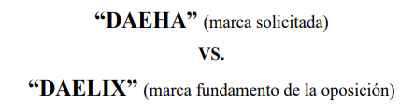
On October 8, 2026, the Federal Civil and Commercial Court of Appeals confirmed that the word mark trademark “DAEHA” may be registered in Class 5 and coexist with the word mark trademark “DAELIX.” Laboratorios Casasco had filed an opposition. It argued that particularly strict criteria apply to pharmaceutical products and that both trademarks share the root “DAE.” However, “DAELIX” protects only products for the cardiovascular system. “DAEHA,” following the limitation proposed by Mega Labs, covers only dermatological medications, emollients, skin protectants, and probiotics.
Why Did the Principle of Specialty Prevail? The Court noted that a trademark protects the goods for which it was registered, and that similar trademarks may coexist for different goods owned by different parties. For an opposition to be upheld, it is not sufficient that the trademarks be confusingly similar: as a general rule, they must relate to the same goods or services, or to goods with excessive overlap or affinity. In this case, the opponent failed to provide conclusive evidence regarding the connection between the products. The burden of proving that connection and specifying which specific items could be confused fell on the opponent.
The New Development: Electronic Prescriptions. The Court acknowledged that it had historically applied a rigorous standard in pharmaceutical matters but noted that “time passes and conditions have changed.” As of January 1, 2025, the electronic prescription is the only valid format for prescriptions throughout the country. This reduces errors caused by illegible handwritten prescriptions, one of the classic arguments used to support a risk of confusion. Therefore, generic arguments regarding illegible prescriptions or imperfect retention of names did not justify a genuine risk of confusion. Even so, the court analyzed the signs and concluded that the endings “LIX” and “HA” distinguish them, particularly the final “X.”
What does this ruling teach us? For the opposing party, it is not enough to invoke a common root or the rigor traditionally associated with the pharmaceutical sector. One must precisely prove which products overlap. For the applicant, limiting the application to a specific therapeutic area can be a decisive strategy. And registration priority only comes into play in cases of doubt, which was dispelled here by the principle of specialty and by the comparison of the marks. Is an especially strict standard still reasonable in the pharmaceutical sector?
For inquiries regarding trademark registration and protection, you may contact our team at info@lermanszlak.com.